Stavanger pronunciation: How to pronounce the place name correctly
 By Rachel · 4 min read
Automatically translated from German. · Read original
The correct pronunciation of Stavanger in Norwegian is [stɑˈvɑŋːər] – with the stress on the second syllable, a long ‘a’ and a soft, almost swallowed ‘r’ at the end.
Key points at a glance
- IPA transcription: [stɑˈvɑŋːər] (standard Norwegian pronunciation)
- The stress is on the second syllable: ‘van’
- The ‘g’ is pronounced like the ‘ng’ in ‘Sang’, not like the ‘g’ in ‘Garten’
- The final ‘er’ sounds like a short, dark ‘a’ (similar to a schwa)
- Population of the municipality: 151,669 (as at 1 January 2026)
How do you pronounce Stavanger in Norwegian?
The place name Stavanger follows standard Norwegian pronunciation (Bokmål/Riksmål). The stress falls on the second syllable. The ‘g’ before ‘n’ becomes a velar nasal [ŋ] – just like the ‘ng’ in the German word ‘Klang’. The following ‘e’ in the ending ‘er’ is not heard as a distinct ‘e’, but as a weak, open schwa [ə] or a dark schwa [ɐ].
A German approximation for everyday use
For native German speakers unfamiliar with the IPA, this approximation helps: ‘Sta‑WANG‑er’. Pronounce the ‘W’ like an English ‘w’ (with slightly rounded lips), draw out the ‘a’ in ‘WANG’ distinctly, and only hint at the ‘r’ at the end – almost like a short ‘a’ in the echo.
Common mistakes and how to avoid them
- Mistake 1: ‘Sta‑van‑ger’ with a hard ‘g’ as in ‘Garten’. Correct: soft ‘ng’.
- Mistake 2: Stress on the first syllable (‘Sta‑van‑ger’). Correct: stress the second syllable.
- Mistake 3: Pronouncing the final ‘er’ too strongly as the German ‘er’ [ɐ]. In Norwegian, it is shorter, almost silent.
Comparison: IPA, German approximation and Norwegian spelling
| Presentation | Content | Note |
|---|---|---|
| IPA (Norwegian) | [stɑˈvɑŋːər] | Standard pronunciation according to Wikipedia |
| German phonetic transcription | sta‑ˈwaŋ‑ɐ | Approximation for German speakers |
| Simple transcription | Sta‑WANG‑er | For quick reading without special characters |
| Norwegian spelling | Stavanger | Identical in Bokmål and Riksmål |
Why pronunciation is important for travellers
With a population of 151,669 in the municipality (as at 1 January 2026), Stavanger is Norway’s fourth-largest city and the administrative centre of Rogaland County. Those who pronounce the name correctly are seen as respectful by locals – particularly in the oil and gas industry, which dominates here, as well as in the tourism sector around the Lysefjord and the Preikestolen. You’ll also avoid misunderstandings on train announcements, at ferry terminals or when booking hotels.
Exercise: Pronouncing Stavanger step by step
- Say “Sta” – a short, open “a” as in “Stadt”.
- Shape your lips as if to say the English ‘w’ and glide into a long ‘a’: ‘waaang’.
- Press the back of your tongue against the roof of your mouth for the ‘ng’ (as in ‘Klang’).
- Let the “er” fade out as a short, dark “a” – almost like a quiet sigh.
- Repeat the whole name fluently: “Sta‑waang‑er”. Place the strongest emphasis on “waang”.
Additional context: The city behind the name
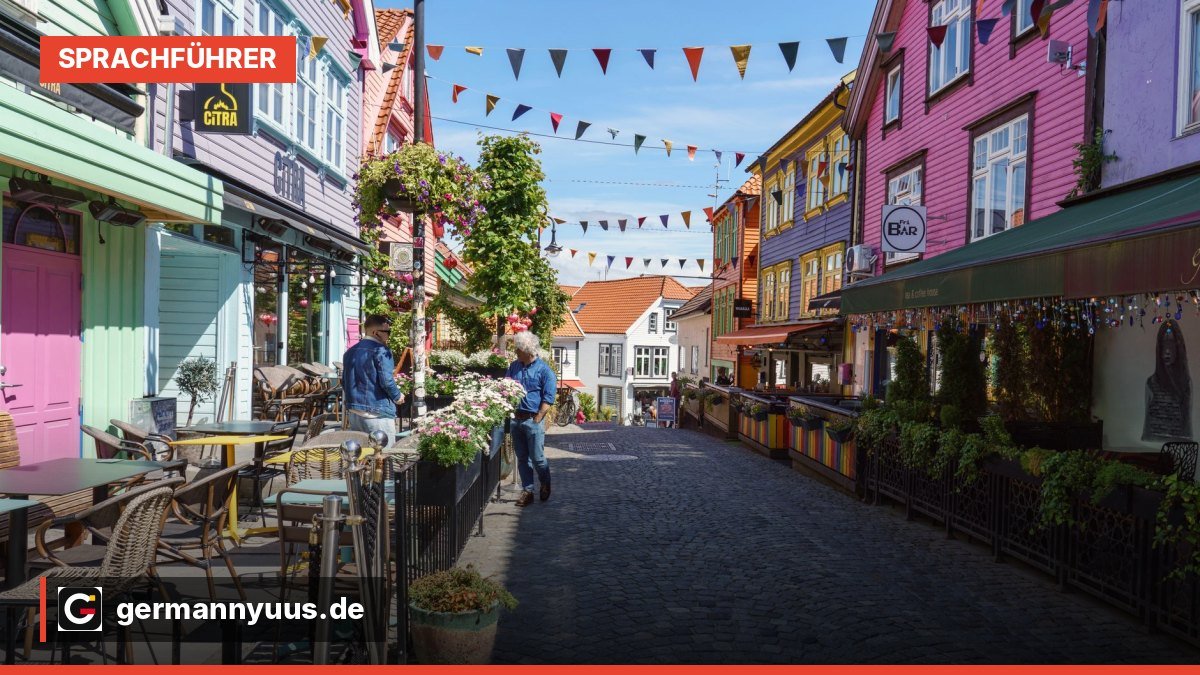
Stavanger was granted town privileges between 1122 and 1125 with the establishment of the bishop’s see. The 12th-century cathedral still dominates the townscape today. In 1825, the sloop ‘Restauration’ set sail from here with 52 emigrants bound for New York – marking the start of the great Norwegian emigration to America. Today, the city is the centre of the Norwegian oil and gas industry; the port of Vågen and the old town district of Gamle Stavanger, with its white wooden houses, attract hundreds of thousands of visitors every year. The Stavanger/Sandnes urban area has a population of 244,378 and is Norway’s third-largest conurbation after Oslo and Bergen.
Frequently asked questions
What is the IPA transcription for Stavanger?
The standard Norwegian pronunciation is written as [stɑˈvɑŋːər] – stress on the second syllable, a velar nasal ‘ng’, and a weak final ‘er’.
Why isn’t the ‘g’ in Stavanger pronounced like a German ‘g’?
In Norwegian, ‘g’ before ‘n’ becomes [ŋ] (like ‘ng’ in ‘Sang’). A hard [g] would sound foreign to Norwegians and make the name unintelligible.
Are there regional differences in pronunciation within Norway?
The standard pronunciation [stɑˈvɑŋːər] is used throughout the country. In local dialects (e.g. Stavangersk), the vowel quality may vary slightly, but the stress and the ‘ng’ remain consistent.
How can I practise the pronunciation before my trip?
Use online dictionaries with audio (e.g. Wiktionary, Forvo) or language apps. Repeat the syllables in isolation, then fluently in a sentence: “Jeg reiser til Stavanger.”
Is the pronunciation different in English?
English speakers often say [stəˈvæŋər] with a short ‘a’ in the first syllable and a stressed ‘æ’ in the second. However, the original Norwegian pronunciation remains [stɑˈvɑŋːər].
Sources: Wikipedia – Stavanger. Last updated: 27 October 2026.