Power cut in Schleswig-Holstein: 40,000 households without power
 By Rachel · 6 min read
Automatically translated from German. · Read original
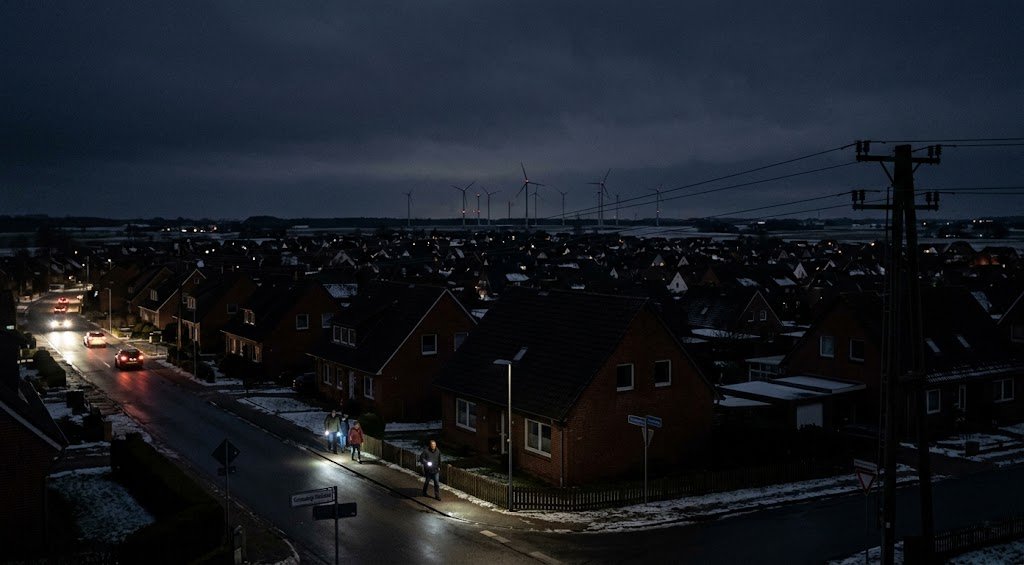
Power cut in Schleswig-Holstein: On Sunday, 18 October 2026, up to 40,000 households on the west coast were without power. At around 9.30 am, traffic lights, heating systems and telephones stopped working; after around two hours, the supply had largely been restored. What remains are fires, damaged infrastructure and an unanswered question: what caused the disruption?
This article summarises what is known so far, where the gaps in our knowledge lie, and what those affected should bear in mind now. You can find further up-to-date reports in our ‘News from Germany’ section.
Power cut in Schleswig-Holstein: What happened on 18 October
The disruption began at around 9.30 am. According to the grid operator SH Netz, a fault in the 110,000-volt high-voltage grid triggered a power surge, causing several substations to shut down. Parts of five districts were affected: Nordfriesland, Dithmarschen, Steinburg, Rendsburg-Eckernförde and Schleswig-Flensburg.
Most customers had their power restored by 11.48 am. After just over two hours, SH Netz gave the all-clear: all substations were back online.
It is worth taking a closer look at the number of people affected. SH Netz spoke of up to 40,000 households, whilst the news agency dpa reported 40,000 people. Both figures are circulating, so the exact number is not consistently confirmed.
Possible cause: a faulty conductor cable near Itzehoe
No definitive cause has yet been established. SH Netz cited a faulty conductor cable on an electricity pylon in the Itzehoe area as a possible source. A damaged cable could have triggered the short circuit and the subsequent power surge. NDR and tagesschau.de also reported on this.
Important to note:
- According to SH Netz, there is currently no evidence of third-party negligence.
- Around 10,000 automatically generated reports from the grid monitoring system are still being checked for anomalies.
- According to the company, it is likely to take some time before the results are available.
The regional newspaper SHZ described the incident as the biggest power cut in Schleswig-Holstein since 2013.
What does ‘overvoltage’ mean and why is it dangerous?
In the electricity grid, the voltage must remain within narrow limits. In the event of a short circuit in the high-voltage grid, it can rise sharply for a short time, even in lines and installations that are not directly affected. Safety devices then shut down entire substations to prevent further damage. That is exactly what happened here.
Substations are the hubs where electricity is converted from one voltage level to another – for example, from the high-voltage grid down to the local networks supplying towns and neighbourhoods. If several of them fail at the same time, tens of thousands of households are quickly affected.
Fires and damage in Dithmarschen
The power surge did more than just cut the lights out:
- Friedrichstadt: A surge arrester caught fire in the substation.
- Linden (Dithmarschen district): According to the police, there was a smouldering fire with smoke emanating from a medium-voltage installation.
- Bunsoh: In a thatched-roof house, an electrical box caught fire, and the blaze spread to the entire building. No one was injured, but the damage is estimated at around 500,000 euros. The police believe there is a link to the power fluctuations.
A regional report in *Nordostsee Magazin* also mentions fires and smouldering fires in Süderheistedt, Pahlen, Albersdorf, Tellingstedt, Osterrade, Sarzbüttel and Schafstedt.
Care homes and mobile networks: where the situation became critical
The situation was most serious in places where people rely on electricity. In care homes in Albersdorf and Friedrichstadt, medically essential equipment temporarily failed, and the ambulance service had to step in to help. The Albersdorf care service later stated that the residents were never in any danger.
On top of this, landline and mobile networks collapsed in several localities. Anyone needing to make an emergency call at such a time faces a double problem. Care, communication and emergency routes all depend on the same network.
Political reactions: FDP calls for a report in the state parliament
The FDP intends to address the incident in the state parliament and is calling for a report to be presented to the Environment and Agriculture Committee. Group leader Christopher Vogt described the scale and the damage as worrying. He said that, as a result of the energy transition, the electricity grid had become highly complex as a critical piece of infrastructure and, at the same time, a potential target for sabotage. He expects a swift and transparent explanation from the grid operator and the state government.
As things stand, there is no evidence to suggest sabotage. Vogt’s statement should be understood as a call for clarity, not as a determination of the cause.
Who operates the electricity grid in Schleswig-Holstein?
SH Netz supplies around 2.8 million customers connected directly or indirectly across more than 900 local authorities and employs over 1,600 people at 30 sites. The company is the largest grid operator in the state. In some towns, such as Kiel, however, the local municipal utility companies are responsible. In the event of a fault, the local grid operator is the first point of contact, not the emergency services.
How common are power cuts in Germany?
Rare by international standards. According to a Statista analysis of figures from the Federal Network Agency, each electricity consumer in Germany was disconnected from the grid for an average of around 11.6 minutes per year. A two-hour outage affecting an entire region therefore stands out, but does little to alter the long-term picture.
The same analysis shows the most common causes of outages. Very often, these are faults within the grid operators’ area of responsibility, such as cable or line faults. These are followed by third-party influences, for example, construction work, road traffic accidents or sabotage. Cases of force majeure and weather-related factors such as lightning, storms or ice are comparatively rare. A faulty conductor cable would therefore fit the profile of a classic grid fault. However, this is a classification, not a finding of the investigation.
What those affected should bear in mind now
Check electrical appliances. Power surges can damage appliances without you noticing straight away. Appliances that are behaving unusually after the power cut should not be used until a specialist firm has checked them.
Document any damage. Photos, receipts and the time of the incident will help when making a claim later. Whether and to what extent your home contents insurance or the electricity supplier will cover the costs depends on the individual case. It is best to clarify this directly with your insurer and the electricity supplier.
Report the incident to the network operator. The network operator is responsible for dealing with faults. Only use the emergency number if there is a risk to life or limb.
Take precautions. You should keep a torch, a battery-powered radio, a fully charged power bank, drinking water and non-perishable food in your home. The Federal Office for Civil Protection recommends a ten-day supply, as SYLT1 emphasises. On Sylt in particular, where electricity, trains and the car ferry come from the mainland, disruptions are often noticed first.
Frequently asked questions about the power cut in Schleswig-Holstein
What caused the power cut in Schleswig-Holstein?
A fault in the 110,000-volt grid led to a power surge, causing several substations to shut down. SH Netz cites a faulty conductor cable near Itzehoe as a possible cause. The investigation is still ongoing.
How long did the power cut last?
Around two hours for most customers. By around 11.48 am, the majority were back on the grid.
Which regions were affected?
Parts of the districts of Nordfriesland, Dithmarschen, Steinburg, Rendsburg-Eckernförde and Schleswig-Flensburg.
Were any people injured?
No one was injured in the house fire in Bunsoh. In care homes in Albersdorf and Friedrichstadt, equipment temporarily failed, but the Albersdorf care service reported that there was no danger to residents.
Was it sabotage?
According to SH Netz, there is currently no evidence to suggest third-party involvement.
How much damage has been caused?
The police estimate the damage to the burnt-out thatched-roof house in Bunsoh at around 500,000 euros. According to the reports available, there is no total figure for all the damage.
Who is responsible in the event of a power cut?
The local network operator – in large parts of the state, SH Netz; in some towns, the municipal utilities.
More on this topic: You can read the latest reports on events across Germany in the News section.